Thursday, October 20, 2016

Best-Practice and Dissonance

This week's post comes from Lisa Lederach, the principal at Cumberland Road Elementary School.  Originally, she wrote this entry to share with the teachers at her school, but her words may resonate with you as well.

From Lisa: I Don't Want to Learn This!

Conversations around HSE21 Best Practices often cause dissonance. Dissonance is unsettling. It is uncomfortable. It doesn't always feel good. Yet we know that learning often involves dissonance as one takes on new ideas and learning.

Steve Loser, one of the assistant principals at FHS, says, "Education should always be supported discomfort." I agree.

There have been many things with my kids that make me say, "I DON"T WANT TO LEARN THIS!" One of those has to do with American Sign Language. I don't want to have to continue to learn American Sign Language. It's so much harder than I thought. I feel stupid when I have to sign in front of people who are deaf. I hate making so many mistakes. I am completely out of my comfort zone. 

Isn't there a faster way to learn this than having to actually work at it?"

I get frustrated and anxious. I avoid going to Deaf Community events because I don't want to feel this dissonance. Yet I know that I need to continue to learn ASL because deeper conversations with my girls depend on it.

So what do I do with this dissonance? What will make it go away? The obvious thing is to put myself out there and continue to learn. Until I know as much sign language as I can, I'm always going to feel this dissonance, this discomfort.

An Example

I took my daughter Grace to a therapy appointment last week. We were saying good-bye to one therapist, Bethany, and hello to a new therapist, Naomi. Therapy sessions are not for the faint of heart, so I am always incredibly relieved to have an interpreter present. You can already guess the next part of the story. Yes, no interpreter showed up for this very important passing of the baton from one therapist to the next.

My heart sank. I could feel my breathing change, and I knew I was going to have to be the one totally in control of expressing myself in ASL. Talk about discomfort. Maybe a better way to think about it is "way out of my comfort zone."

People in the Deaf community are incredibly kind if you put your best foot forward and simply try. They are gracious, they are forgiving, and they honor the intentions behind the mistakes. So I plunged in and spent 45 minutes in an English free environment as we all talked about Grace, her goals, her progress, and therapy plan. There were actually times when I didn't even think about the fact that I was signing.

And mistakes? I made so many, but I gutted through them, identified that I was making mistakes, and just kept going. These 45 minutes were too precious to waste being afraid I might mess up.

The baton was passed, Grace left with a smile, and I said good-bye to Bethany and Naomi.

HSE21 Best-Practice

The dissonance of HSE21 Best-Practice probably won't go away for a very long time, just like my discomfort with American Sign Language won't go away for a very long time. Learning ASL is a lifetime commitment for me. Supporting HSE21 Best Practice is a career life commitment for me.

Live in the dissonance. Know you are not alone.  We all feel discomfort and work to find our way through the HSE21 Best Practice maze. It helps to think about it as a five-year journey, so extend grace to yourself and others. Don't waste precious time being afraid you'll mess up.

We are running a marathon, not a sprint, and the baton passing is done by a team, not alone.


Respond to Lisa at llederach@hse.k12.in.us


We hope you had a good Fall Break and have a great week, HSE.

Your HSE Teaching and Learning Team

  • Jan Combs, Assistant Superintendent of Teaching and Learning
  • Stephanie Loane, Director of Elementary Education
  • Tom Bell, Director of Special Education
  • Jeff Harrison, Director of Educational Technology
  • Phil Lederach, Director of Secondary Education

Friday, October 14, 2016

High Impact Thinking

This week's entry comes from Laura Schultz, fifth grade teacher at Hamilton Southeastern Intermediate and Junior High School.  You've all heard the saying, "It's like riding a bike...."

Laura takes another look at what that might mean for us and for our students.

Enjoy!

From Laura Schultz...

Failure and Growth:  A Recursive Connection

In my fifth grade classroom, we lightheartedly call ourselves “The Best Failures” in the school! 
These learners know that to be a “great failure” means that with help, success is just around the corner.   They can articulate this to anyone who should warrant an explanation for such a seemingly ludicrous comment because they consider themselves collaborative learners and understand that the impetus for true learning is derived out of mishaps, blunders, miscalculations and, well…failures. 


One metaphor we use for this is “riding a backward bicycle.”  Learning to ride a bike is a rite of passage that occurs in steps and is much like the learning process itself.  Beginning bike riders come to know that the most intense learning is born from the bumps, bruises, and scrapes that occur during the failure-to -launch stages. Deep understanding requires high impact thinking on the part of the learner.

Backwards Brain Bicycles and Metacognition

Last school year, Dr. Loane introduced us to a video from the Smarter Every Day series that highlighted the stages the vlog’s host and narrator, Destin Sandlin, went through while relearning how to ride a bicycle that had been “tricked out” to operate in an opposite fashion than what he had trained his brain to do from the beginning as a bicycle rider. 
This screenshot is from the YouTube video.
What if it's not like riding a bike?


This entertaining video emphasizes all of the stages Destin experienced while relearning this process. Throughout, he graciously accepts his failures as opportunities to be successful.  The reflective nature of the video itself highlights for the viewers the necessary application and transfer of skills required to conquer his personal learning outcome. 

When deciding to discover what my learners understood about their own “thinking about thinking” reading strategies, the bicycle video immediately came blasting into my brain. So, they watched it.  Needless to say they were enthralled.  They couldn’t wait to share their own stories of failures and successes about learning how to ride a bike!  The video and the subsequent enthusiasm for failing turned out to be a great segue into the reading experiment that was about to follow.
Watch the video at:
Backward Bike


Zones: Confidence, Learning and Panic

Dr. Michael McDowell, the keynote speaker at a recent Indiana Middle Level Education Association conference, likened learning to a three-ringed target where each of the rings is a zone. The very middle of the target is a confidence zone, the middle ring is the learning zone, and the outermost ring in the panic or chaos zone. 
Which zone are you in most of the time?

Obviously, the confidence zone is the easiest place to live, but living there is impossible without passing through all of the other zones, often more than once. After many discussions about what type of learning occurred in each of the zones for our backwards bicycle rider, my students watched the video once more labeling the zone that Dustin was in and the reasons why he fell into any one particular zone while on his journey to reach his learning outcome. 

I wondered aloud if the learners in front of me could speak to the zone they were actually in during the reading process. Would they panic?  Would they fall off the metaphorical bike?  Or, would they confidently ride off into the sunset?   

Most took this as a challenge, and so our work began.

Data and Kidblog

Paired learners went to work listening to one another read an article I purposefully assigned that was at their frustration levels. The readers read while thinking aloud about the metacognition they were using during the reading process itself.  The listeners used a tally mark system to count the number of times they heard the reader comment about a learning strategy they consciously used to make meaning. 


Once they finished, they switched reader and listener roles, and the data was returned to the appropriate reader and analyzed for metacognition. The results drove a further discussion about what zones they felt they were in regarding the use of reading strategies during this process. 

What amazing comments ensued from the learners! 

They spoke about being in a panic zone, falling off a bike, and needing help. Students blogged their ideas as an assessment for all to read.  In this way, they learned from many more of their peers, and not just from the one they were originally paired with.    

A few comments from the blogging site Kidblog have been copied below.  I’m hopeful that many more comments and conversations cycle around our Humanities class regarding problem solving when traveling from one zone to the next.


A Follow Up: The Learning Pit

I encourage everyone to visit James Nottingham’s (founder of Challenging Learning) website.  There you will see a video that likens learning to landing in a pit.  The premise is that learning involves being stuck in the pit, feeling confused, and experiencing failures. 


The only way to climb out of a pit is through challenge and collaboration.  


At HIJH, we seek to challenge, collaborate, and together experience growth for all stakeholders in the learning process.


Respond to Laura at lschultz@hse.k12.in.us
We hope your week is spent sometimes in the Comfort Zone, but often in the Learning Zone.  If you get into the Panic Zone, check out the ideas on the right side of the Learning Pit!

Your HSE Teaching and Learning Team
  • Jan Combs, Assistant Superintendent of Teaching and Learning
  • Stephanie Loane, Director of Elementary Education
  • Tom Bell, Director of Special Education
  • Jeff Harrison, Director of Educational Technology
  • Phil Lederach, Director of Secondary Education


Friday, October 7, 2016

The Deep End

This week's entry comes from Jeff Harrison.  Do you ever feel like you're in over your head?  (That is a rhetorical question for educators!  We all feel that way at times.)  When you do, Jeff has some advice he learned while celebrating his daughter's birthday.  Enjoy!

From Jeff: Taking Risks

Wear a life jacket and stay at the shallow end,
or use the slides at the other end....
To celebrate my daughter’s eighth birthday, we held a pool party at an indoor pool. The pool was a zero entry design (starts off very shallow and progressively gets deeper).  It was divided at about the three foot depth with two water slides on the deeper side. For liability reasons, the facility required a swim test. If a child did not pass the swim test, he or she had to stay on the shallow side with a life vest. Those who passed the swim test were permitted to use the entire pool and best of all, go down the water slides.

The swim test allowed the kids to use whatever stroke or strokes they preferred, and they could take as long as they needed. However, they had to go the entire length of the lap pool (25 yards) without touching the bottom or the sides.

There was one child—we will call her Marge—who was intimated by the swim test. Marge had taken swim lessons and swam all summer, but something about going 25 yards caused panic.
She had the skill, but it looked so far away.


During Marge’s first try, she jumped in and took off but had to stop about a quarter of the way. She didn’t give up.  She got out of the pool and back in line. Her second attempt was not any better, and frustration began to get the best of her.  

She was tempted to leave, but she had adults and pool staff who encouraged her to give it a third attempt.

The third time she was coached beforehand.  She was advised to jump in, stand up, look at the end of the pool, and then begin swimming. She was encouraged to start easy with the back stroke, and when she felt comfortable, to roll over. As she began swimming, one of the lifeguards walked along the length of the pool, encouraging her with every stroke.


Before she knew it, she was at the halfway mark. A few strokes later, however, panic set in.  We could see it in her eyes.  The lifeguard at the side of the pool assured her that she was almost there.  He asked her to give it 10 more strokes, and he counted down with each stroke she took.  When she hit zero, Marge touched the wall and had passed the swim test. She was relieved and elated! 

Swimming in the Educational Pool

Marge had the training and skills to pass the swim test, but she had to take a risk to jump in and try—more than once. When she struggled, she had mentors ready to coach and encourage her along the way.

This experience reminds me of what educators are encouraged to do all the time: take risks!  John F. Kennedy said, "Only those who dare to fail greatly can ever achieve greatly."

It is only when we take risks that we can grow in our practice. The great thing is that we can take risks without fear. Just like the lifeguard on the side of the pool, we have Teacher Leaders, Media Specialists, Teacher Development Specialists, Instructional Coaches, Department Chairs, and building and central office administrators ready to jump in, provide support, and help us reach our goals.

The advice to Marge is good: Jump in, stand up, look at the end goal, and begin swimming.  Start with an easy stroke.  Move on to other strokes as you go.  When panic sets in, listen to advice from others, but keep swimming.  

It’s much more fun to play in the deep end!

Jeff, when not in his office!


Respond to Jeff at jharrison@hse.k12.in.us


Have a great week, HSE.  Jump in and have some fun!

Your HSE Teaching and Learning Team
  • Jan Combs, Assistant Superintendent of Teaching and Learning
  • Stephanie Loane, Director of Elementary Education
  • Tom Bell, Director of Special Education
  • Jeff Harrison, Director of Educational Technology
  • Phil Lederach, Director of Secondary Education

Can you relate to this?


Thursday, September 29, 2016

Sealing Knowledge

This week's entry comes from David Young, the English Department Chair at Hamilton Southeastern High School.  It is in response to early entries from Brent Farrell and Jan Combs.  Enjoy!

From David Young: Jet Fuel, Concrete, and Thinking

As an English and Journalism teacher who was raised by a family full of teachers, I make connections where there seemingly are none to be made; I’m blessed and cursed to find the “lessons” in everything.


These days, we hear a lot about teachers being asked to change their mindsets about teaching and learning, which I see as a very difficult task for many; after all, it’s almost impossible to change certain items once they have set. One of the most difficult substances to change once set is concrete, which was what I happened to be working with at 5:00 a.m. on Labor Day this year.

A few years ago, my wife and I had a stamped concrete patio poured alongside the back of our house, which requires a re-sealing every year to maintain. Just as I have done the past three years, I prepped the job the day before: I checked the weather forecast, cleaned and power washed the concrete, and got my brush, roller and the 5 gallon bucket of sealer out, so that the only things left to do were wake up and start. (If you don’t know, sealing concrete is just like painting, except you can’t see where you have painted until the sun comes up.)

Even though it was before dawn that day, I kept thinking back on the "Catch and Release" and "Let It Go" Teaching and Learning blogs from this year. Analogies stick with me (the fact that I was inhaling very strong fumes to start the day might have had something to do with it!).
To avoid a re-do, David planned carefully before
sealing his concrete patio.

You see, concrete sealer (along with being expensive, highly flammable and smelling like jet fuel) has very specific application directions: you can't apply it in direct sunlight, when it's too hot or cold, too thick or thin, or when rain is forecasted for 24 hours—not an easy task to master for someone who only does this once a year—and all have different repercussions if you do. 

If you put the sealer on too thick, when it's humid, or when rain is forecasted, moisture gets stuck between the layers as it dries, causing it to cloud over and look terrible (and you have to redo it all). If you apply it in direct sunlight or when it's too hot or too cold, it will bubble and not stick, causing the seal to fail and crack (and you have to redo it all). If you apply it too thin, it will wear off early and possibly damage the concrete (and you have to redo it all). But, if you do everything correctly, the end result is an amazing-looking finish that is more durable and helps the concrete last longer.
The end result is worth the effort.

Maybe you've already made the same education connections as I did, but to me sealing concrete directly relates to how I cover content in my classroom—the same line of reasoning as the sealer directions: if I lay it on too thick or alongside unrelated material, meaning becomes cloudy; if I’m not paying attention to the environment around me or if I don't give content time to breathe and soak in, meaning and skill won’t stick (or may get stuck without wanting to like the two crickets who met their untimely death that morning); if I don't cover my bases well enough by preparing early and checking my students’ skill level, the meaning can have no purpose and be a waste because the time or skill level were not right.

My take-away lessons:
  • Teaching is about depth, not breadth;
  • Sometimes process is more important than product;
  • It’s easy to mess up or miss something important without close reading skills;
  • Mess-ups require re-dos;
  • Slow down and take the time needed;
  • Do the necessary prepping and pay attention to the steps along the way;
  • Take a step back occasionally to see the “before” and “after”;
  • Find a well-ventilated area when needed; and
  • Even though the process sometimes stinks, it’s more than worth it in the end if done with care.

If I keep these things in mind—whether in sealing my concrete patio each year or with the lessons in my classroom—the end result will always be much more enjoyable and meaningful, sometimes even for years to come.


Respond to David at dyoung@hse.k12.in.us


Have a great week, HSE.  Seal their knowledge this week with careful preparation and by going deeper rather than wider.  If things don't go well, back up and take a "re-do"!

Your HSE Teaching and Learning Team
  • Jan Combs, Assistant Superintendent of Teaching and Learning
  • Stephanie Loane, Director of Elementary Education
  • Tom Bell, Director of Special Education
  • Jeff Harrison, Director of Educational Technology
  • Phil Lederach, Director of Secondary Education

Links to the entries that started David's thinking:


Friday, September 23, 2016

One Bite at a Time

Don Koewers teaches third grade at Cumberland Road Elementary.  This week, he shares the approach their Technology Team took to prepare for all students having access to iPads. Their work helped focus efforts at CRES--and can be a model for implementation of any kind of change at any level

What happens when you focus your efforts and get really good at a few things before moving on to something new?  Don helps answer this question.

From Don: When Less is More

As we began our 1:1 journey, two wise people asked us, "How do you eat an elephant?" Of course the answer is one bite at a time. 


After a year of having iPads in the classroom, the pilot team had to decide the best way to help our staff tackle this new endeavor.  We did our homework. First, we were fortunate to have Nadine Gilkison visit our school and talk to our staff about technology in the classroom. One of the most important points that Nadine shared was that curriculum comes first, and then we choose a tool that enhances what we have to teach.


Spoiler Alert: Katie Muhtaris is going to join u
on November 8.  Sign up for one of her sessions
if you want to Amplify your instruction!
Second we read Amplify. In this book, the authors, who are teachers themselves, share their views on how to use technology to "amplify" instruction. Again, we came across that idea of not recreating our teaching practice, but taking the great teaching already going on in our classes and making it more impactful on students by blending in technology.


What do you do when you have so many resources to choose from?

Kristin Ziemke, co-author of Amplify, shared that she had eight basic, yet flexible tools that she uses with her students. Our design team set out to identify what those tools might be for our teachers and students. We wanted tools that had the greatest effect on student learning. 

Our work and experience led to the list of resources seen in the infographic below. Our list includes more than eight, but we know that each tool allows for teacher-choice and leads to creation rather than consumption.  

These tools give us a common place to start, but they are not the end of our journey!
What happens when you focus efforts and get really good at
a few things before moving on?


Hawaiian Day at CRES!


Respond to Don at dkoewers@hse.k12.in.us 


We hope your week is a good one, HSE.  Take one bite at a time....


Your HSE Teaching and Learning Team
  • Jan Combs, Assistant Superintendent of Teaching and Learning
  • Stephanie Loane, Director of Elementary Education
  • Tom Bell, Director of Special Education
  • Jeff Harrison, Director of Educational Technology
  • Phil Lederach, Director of Secondary Education


Friday, September 16, 2016

Confidence and Competence

Bob Probst and Kylene Beers
On opening day, all of us were at Fishers High School to kick off the school year, and we all had the privilege to hear from Kylene Beers and Bob Probst.  They shared some thoughts about their most recent book.

Kylene said something that morning that has stuck with me: “You cannot get to competence without first getting to confidence!”  In response, I put together a series of blog posts for teachers at Riverside Intermediate to help build confidence in the ways we teach nonfiction reading strategies. 

Today’s entry is summary of these three posts.  If you’re interested in the full versions, I’ve included the links at the bottom.


1)      Three Key Questions: Taking Students Further

After the opening day celebration, many of us were able to gather for a longer professional development session with Kylene and Bob.  One of the things that Kylene said was, “Some teachers don’t realize that if they just stay out of the way, the kids who do well will keep doing well.  How do we take them further?” 

Throughout the day we were pushed to think about how we could help our students dig into the text, think deeply about it, and take away their own understanding of that text.  Reading, especially nonfiction reading, requires an interaction between the reader and the text.

Best-Practice takes students further....
In order to get students to start that interaction with nonfiction, Kylene and Bob suggest we should start with three simple questions:

1.      What surprised me?
2.      What did the author think I already knew?
3.      What changed, challenged, or confirmed what I already knew?

Kylene made a distinction between interest and relevance: “Asking these questions makes the reading more personal and relevant.  Interest is not relevance!  Getting kids’ attention is about interest.  Keeping their attention is about relevance.” 

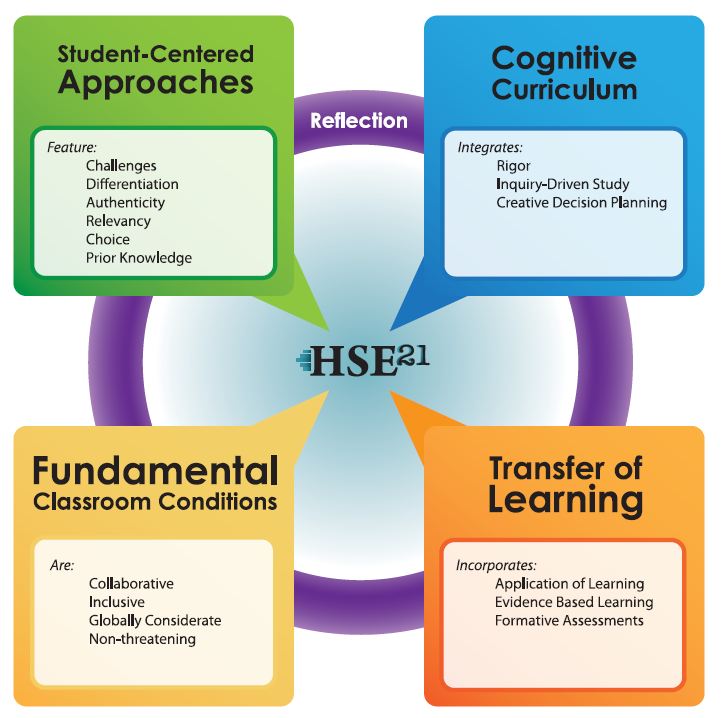
This is what the HSE21 Best Practice Model is pushing us to do: Make learning authentic and relevant for our students.

2)      A Question for Us: How Do We Define “Nonfiction” to Students

Kylene and Bob led us in a conversation about the definition of nonfiction.  Take just a moment to answer these questions. 


 If you’re anything like me, the definition you are likely to share would be something similar to “not fake” or “factual” or “real.”  I took a quick survey of the staff in my building, and created the word cloud below based on the definitions they shared with me.  You’ll notice that many others define “nonfiction” the same way I did. 


Kylene and Bob, however, pointed out a problem with the definitions many of us use with students.  In Reading Nonfiction, Beers and Probst suggest variations on this definition:
“Nonfiction is that body of work in which the author purports to tell us about the real world, a real experience, a real person, an idea, or a belief.” 

The key word here is purports

For those of us who enjoy reading fiction, we know the excitement that goes with getting lost in the story of a book.  We should not get lost in nonfiction writing in the same way that we get lost in fiction because the author’s purpose may slant the writing in some way.  Not all nonfiction is “factual,” “true,” or “real.”  In fact, some is intentionally untrue or misleading.

In their book, Kylene and Bob suggest age-appropriate ways for students to develop a deeper understanding of what nonfiction is and just as important, what it is not.

3.      A Question about Purpose: Why is the Word “Purports” so Important?

To help understand how an author’s purpose plays a role, think about today’s coverage of the election:

All the major news outlets likely covered the same stories today.  Since most of us can’t watch live, we can tune in to the news to see what happened.  Depending on what station you turn to for your news, the message will be different. If you watch coverage of the story on ABC, CBS, NBC, CNN, Fox News, MSNBC, and PBS, you will almost certainly see vastly different slants on the exact same event.  You can find the same variations in the print media.
Why is it important to teach our students to take a
questioning stance when reading nonfiction?

If we teach our students this definition: nonfiction = not fake (something I specifically remember one of my teachers writing on the board), then how do our students process those varying takes on a news story?  How do they read that email from a prince in the Middle East and realize that it’s a hoax?  How do they become participants in a democracy when democracy relies upon an informed public?  We have to challenge our students to enter reading with a questioning stance, to always look for the ways that authors might be trying convince us that their version of the message is the correct one.

If you have not yet read Reading Nonfiction, I can’t recommend it highly enough.  This year I have seen examples of nonfiction reading instruction taking place in math, science, history, music, art, and language arts classes in our building.  No matter what you teach, there are times that students will do some form of nonfiction reading in your classroom environment, and the strategies you use have the ability to impact the nonfiction reading skills of your students. 

Help them see the value of strong reading skills by integrating the three questions, talking about the author’s purpose, and seeking out and discussing the nonfiction signposts in the materials your students are reading. 

And don’t forget to sometimes just get out of the way of your students.   If you teach them the tools, their conversation will be just as deep, if not deeper, than any our planned questions could generate.

Click the link to see Brian's Blog

If you’d like to read the three complete posts that I put together for the RSI staff, here are links.  Feel free to add your thoughts on this topic in the comments section!


Respond to Brian at bbehrman@hse.k12.in.us


We hope your week is a great one, HSE.  Keep taking students further....

Your HSE Teaching and Learning Team
  • Jan Combs, Assistant Superintendent of Teaching and Learning
  • Stephanie Loane, Director of Elementary Education
  • Tom Bell, Director of Special Education
  • Jeff Harrison, Director of Educational Technology
  • Phil Lederach, Director of Secondary Education


Friday, September 9, 2016

Visual Supports Help Everyone

Universal Design for Learning (UDL) provides a blueprint for creating instructional goals, methods, materials, and assessments that work for everyone.  Contrary to common perception, these are not lessons just for special needs students.  Laura's goal with this entry is to give you a visual support for thinking about how powerful learning can be when students help other students and UDL principles are part of the experience.
Visual Supports help students on the Autism Spectrum.
Interestingly enough, they help you and me, too!
Look how this graphic can help summarize a complex topic.


From Laura: How Visual Supports Can Help Students on the Spectrum

Last Wednesday I watched a fourth grade student on the autism spectrum gleefully have snack at the back table, enjoying his pretzels and a glass of water.  On Thursday, however, when the teacher called the student to the same table to make a sensory calming bottle, the student got very upset and started crying out for pretzels and water.  He assumed that when he sits at the table, it’s time for snack. 

We could have avoided the meltdown by placing a picnic blanket over the table during snack time to make it visually clear what is happening during that time.  Many of our students need visual supports.  This is true for our youngest learners in the district in our early childhood programs, but this is true at all levels. 

Students Helping Students

Several of our early childhood classrooms used foam dividers to help students learn how to navigate the space in their classrooms.  When the dividers are up, the play area is closed.  The ultimate goal is to teach our students when it is appropriate to use each area, and the visuals help provide a scaffold to the students and have been very successful. 
Gunnar Rich  and Josh Leroux.  Why does authenticity
increase learning and engagement?


Unfortunately, last year the fire marshal told the early childhood teachers they could not keep the foam dividers in their classrooms because they are a fire hazard.  While fire resistant products are available for purchase, they are quite costly.  We had to come up with a different plan.

We were able to connect with several students at Hamilton Southeastern High School who were participating in the Project Lead the Way program.  We asked them to help us solve our problem.

Gunnar, one of the students involved in the project, shared this about his experience:
Students invested in their work don't see it as "schoolwork" or
"homework."  What kind of assignments get students working
during their free time?  Ask Josh and Rich.


Josh and I approached the project by following the "engineering design process.”  We started by defining the problem, which involved meeting with the teachers who would use the dividers to discuss what they needed in an effective "product.”  In this step, we tried to understand what was needed in terms of overall size, storage, stability, maneuverability, and fabric.

Next, we researched ways that similar problems have been solved before and brainstormed possible designs. I communicated with the local fire department to discuss what was needed in order for the dividers to meet the necessary safety standards. Then, we compared the possible designs in terms of the criteria that the schools desired, as well as for cost and ease to build.

After coming to a decision on the best design, we finalized the dimensions of our sketches so that we could give a cost estimate based on the materials. We built Iteration One of the prototype, with help from another student who had experience with sewing, and we presented it to teachers who gave us their feedback. We made changes, including sewing the fabric to the top edge of the frame. Shortly thereafter, we delivered Iteration Two of the prototype for the schools to actually use for a period of time in their classes.
See the HSHS PLTW website at this link:
Project Lead the Way

After getting feedback, we came up with the final iteration of the dividers, which was slightly taller and could be fastened at the bottom edge of the frame using Velcro. We are still finishing up building the last of the 27 dividers and getting the fabric sewn. It has been almost a year now since the project started. We have been working on the project when we have free time during our study hall.

If you ask Gunnar and Josh, they will tell you that this real-life design project provided rich opportunity for learning and real satisfaction at being able to help other students.  When we talk about HSE21 and authentic learning, think about Josh and Gunnar.

Visual Supports: Your Turn

For students with autism, visuals are vital.  The brain processes language differently when it is spoken as opposed to when it is written or when communication occurs with pictures.  Defining space for students also creates a visual for students on the autism spectrum.  It can reduce anxiety and help avoid a meltdown. 
The final product in the classroom.  It looks like a blank screen,
but when you know the story, it takes on a whole new meaning.

And if truth be told, visual supports are not just helpful for students on the spectrum.  We can all benefit from visual supports.  One of the basic tenets of Universal Design for Learning is that good instruction is good for everyone, not just special education students.

Take another look at the picture of the final project from Josh and Gunnar.  From now on, whenever you see something similar, let it be a visual reminder of what authentic learning can look like, and perhaps it will encourage you to find ways to involve your students in helping others in the school, in our community, or in our world.

That type of lesson is good for every child in every classrooms!

A perfect visual for a world traveler.


Respond to Laura: lrinderknecht@hse.k12.in.us


Keep designing lessons that work for all students, that include authentic performance tasks, and that make a real difference in the lives of students.  It's not easy to do.  It's not going to happen every day, but when we manage to craft these kinds of lessons, there is no question that we deepen student learning and engagement.

Have a great week, HSE.

Your HSE Teaching and Learning Team
  • Jan Combs, Assistant Superintendent of Teaching and Learning
  • Stephanie Loane, Director of Elementary Education
  • Tom Bell, Director of Special Education
  • Jeff Harrison, Director of Educational Technology
  • Phil Lederach, Director of Secondary Education